Lead with Clarity. Navigate Change with Confidence.
Schools are being asked to make decisions about AI before they've had time to think clearly about what actually matters. New tools, new expectations, and new risks are appearing faster than most leadership teams can evaluate them. This moment isn't about adopting AI. It's about leadership judgment — deciding what belongs in your school, what doesn't, and what can wait.
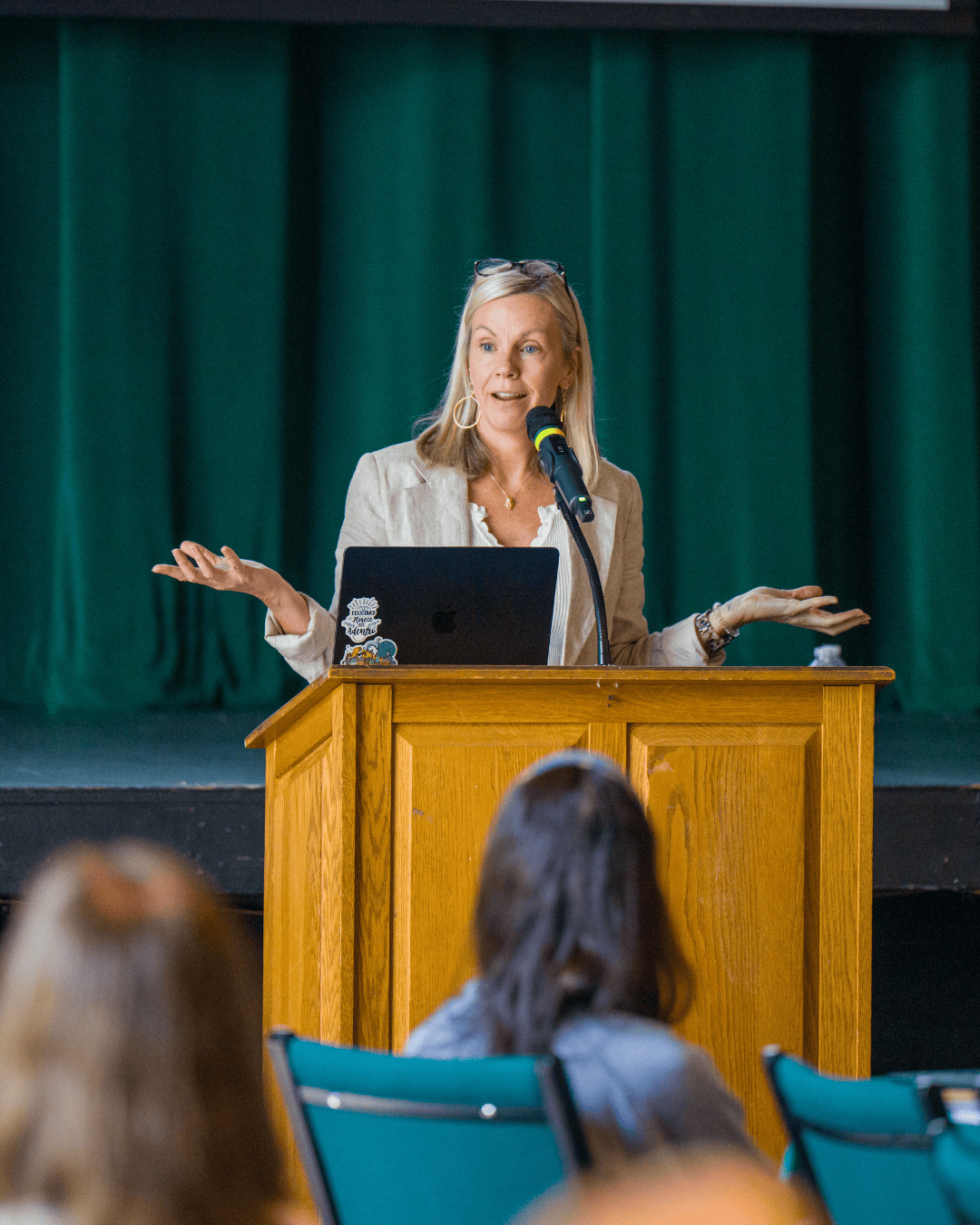
I've spent the last two years building AI systems for enterprise clients and training professionals to operate in the humans + agents economy. I lead the 49 on-demand workshops and core methodology that form the foundation of this program.
I'm an educator and founder of The PATH from EI to AI™ — a framework that approaches AI readiness as a developmental process before a technical one. Former Head of School with experience leading K-12 transformation. I help school leaders create clarity to reduce pressure, especially when things feel urgent and it's hard to tell what actually matters.
AI is no longer limited to single tools used by individuals. Systems can now assist with communication, planning, documentation, and analysis — often running in parallel across teams.
Schools don't need to rush into this. But they do need to understand what's changing so decisions aren't made reactively, inconsistently, or by default.
Over the next few years, schools will encounter AI in two primary ways:
Intentionally design systems — to support communication, curriculum, and operations
Inherit systems by default — as tools and vendors quietly embed AI into daily work
In both cases, the leadership skills required are the same.
Five capabilities schools need. These are not technical skills. They are leadership capabilities — made visible and supported by AI.
Workflow Engineering → Map and improve how parent communication, enrollment, and staff coordination actually flow — so work is faster, consistent, and not dependent on one person.
Deliverable Engineering → Produce board reports, strategic plans, accreditation materials, and parent-facing communications that are clear, aligned, and ready on time — without starting from scratch each cycle.
Performance Engineering → See where time, effort, and trust are leaking across enrollment, reporting, and compliance — and fix the root cause instead of adding another initiative.
Context Engineering → Build a shared source of truth — policies, values, patterns, and institutional memory — so tools produce responses that actually sound like your school.
Agent Orchestration → Responsibly automate follow-ups, planning, and analysis — with clear oversight — so your team can serve more families without losing consistency or control.
When these capabilities are built in sequence, leaders gain leverage — not through speed, but through consistency and judgment.
Black Belt 01
AI Workflow Engineering
Nine practical modules where school leaders learn by applying AI to their own work — parent communication, enrollment, and internal coordination — not hypothetical examples. Included in the bundle.
Free until January 31
01
Grey Belt
📄No Session Assets
02
White Belt
03
Yellow Belt
04
Orange Belt
05
Green Belt
06
Blue Belt
07
Purple Belt
08
Brown Belt
09
Black Belt
"This course fundamentally changed how I work with AI — not just as a productivity tool, but as a thinking partner that supports leadership decision-making, planning, and reflection."
Richard HengelbrokEducational Consultant & Former International and Bilingual School Leader
02
Black Belt
Deliverable Engineering
Purchased separately: $1,000
Why It Matters for School Leaders
This isn't about making better documents. It's about producing clear, aligned deliverables using your school's real work — board reports, strategic plans, accreditation documents — so decisions are understood, supported, and trusted.
The school leader who can prepare a compelling board presentation without weeks of back-and-forth builds credibility faster. The administrator who can create consistent, situation-specific parent communication serves families better — without reinventing the wheel each time.
And it's not limited to static documents. You'll build practical tools — readiness assessments, curriculum maps, dashboards — that directly support your school community and leadership team.
What You'll Build
Board reports and strategic planning documents
Accreditation materials and compliance documentation
Curriculum guides and professional development materials
Interactive tools — readiness assessments, progress trackers, intake forms
Communication materials that serve your entire school community
"By the end of the course, I was able to confidently design and implement AI-driven workflows that I now use in my role as Executive Director of a K–12 charter school."
Melanie MarroneExecutive Director, K–12 Charter School
03
Black Belt
Performance Engineering
Purchased separately: $1,000
Why It Matters for School Leaders
Every school has critical processes that rely more on habit and memory than shared clarity — enrollment steps that vary by registrar, reporting workflows locked in one person's head, or handoffs that slow things down without anyone fully seeing why.
This training helps leaders use AI to make work visible — so you can understand how enrollment, communication, and compliance actually function across your school, identify friction points, and improve them intentionally.
The goal isn't monitoring performance. It's creating systems that are clear, consistent, and resilient — even as people change roles or leave.
What You'll Master (by working with your school's real processes)
See how core school processes actually operate — and where time, effort, or clarity is being lost
Document and standardize enrollment, communication, and reporting workflows
Capture veteran staff knowledge and turn it into shared, repeatable systems
Design improvements that survive staff transitions
Support stronger, more consistent performance across your administrative team — without adding oversight burden
"Just two classes in, I realized I hadn't even scratched the surface of what AI could do for my work. The way Mary teaches makes complex systems feel clear, usable, and immediately applicable."
Crystal DiMiceliEnvironmental Educator & Program Founder
04
Black Belt
Context Engineering
Purchased separately: $1,000
Why It Matters for School Leaders
AI systems only work well when they reflect the values, policies, and norms of the school using them. Without clear context, tools produce generic responses that feel disconnected from your community and risky to use.
This training focuses on helping leaders build shared sources of truth — policies, practices, and institutional knowledge — so AI-supported work remains consistent, appropriate, and aligned with your school's voice.
The goal isn't collecting more data. It's ensuring continuity, clarity, and trust — even as staff, tools, or vendors change.
What You'll Learn
Design school context resources that grow more useful over time
Organize policies, values, and communication norms into usable reference systems
Preserve institutional memory so leadership knowledge isn't lost with staff turnover
Structure information so AI tools support consistency — without exposing sensitive data
Translate team knowledge into shared, documented practices
"I'm amazed by how much can be accomplished with AI — not by finding new tools, but by using it to move real work forward. Having AI act like a project manager helped me stop trying to figure everything out on my own."
Cyndi RathbunIT Director, K–12 Charter School
05
Black Belt
Agent Orchestration
Purchased separately: $1,000
Why It Matters for School Leaders
Agent orchestration is not the starting point — it's what becomes possible after clarity, safety, and strong leadership systems are already in place. Once core workflows, deliverables, and context are clear, schools face a different question:
How do we support more families, more needs, and more complexity — without exhausting the people we have?
Agent orchestration focuses on coordinating AI-supported systems so routine communication, planning, and analysis can run with oversight, freeing leaders and staff to focus on judgment, relationships, and care.
This is not about replacing people. It's about ensuring your school's systems can grow in consistency and capacity — even when budgets, staffing, and time cannot.
What You'll Learn
Design coordinated AI workflows that support — not replace — human decision-making
Build automated communication and follow-up systems with clear review points
Create feedback loops that help schools respond more consistently to families
Support parallel planning and analysis without overloading staff
Increase capacity responsibly, without increasing headcount or risk
"Building this program forced me to live it. I now run multi-agent systems that produce client deliverables, research, and content while I sleep. Things that would have taken my team weeks now happen in hours. Agent orchestration is how I run my business today."
Everything in the standard program — plus dedicated coaching to translate these skills into education language.
Weekly Live Calls
Join Mary every week for live coaching sessions focused on applying the curriculum to school-specific challenges. Bring your real projects, get real feedback.
School Leaders Peer Community
Learn alongside other school administrators facing the same challenges. Share workflows, compare notes, build relationships that extend beyond the program.
Translation to Education Language
Mary bridges Steve's frameworks to your world — parent communication, board reporting, curriculum planning, stakeholder engagement. No more figuring out "how does this apply to me?"
Real School Use Cases
Work on actual school projects during coaching — enrollment automation, parent communication systems, accreditation workflows. Leave with working systems, not just ideas.
This is everything in the standard $1,000 bundle — plus dedicated school leaders coaching at no additional cost.
The Community
The AI Operator Community
You don't learn this alone. Weekly workshops, a private peer group, and certifications that prove you've done the work.
49 On-Demand Workshops
Asynchronous training covering real production workflows. Learn at your own pace, revisit anytime, apply immediately.
Private Peer Group
Connect with other operators building these skills. Share workflows, troubleshoot challenges, learn from each other's builds.
5 Black Belt Certifications
Earn credentials in each discipline. Demonstrate mastery to clients and employers with certifications that mean something.
Same access, same benefits. Just 10x the price. The January offer is a one-time opportunity.
White Belt Session Assets
Copy these prompts into the LLM of your choice (ChatGPT, Claude, Gemini, etc.) to follow along with the session.
Goal + Obstacle (Template)
I'm trying to GOAL and I'm struggling with OBSTACLE. List all the ways you can help me.
Goal + Obstacle (Example)
I'm trying to GET IN BETTER SHAPE and I'm struggling with EATING HEALTHY AT NIGHT. List all the ways you can help me.
Book Cover (Template)
I help _____ do _______, and I'm writing a book called ______. Create a book cover for me.
Book Cover (Example)
I help leaders create an AI Humanist culture, and I'm writing a book called The AI Humanist Blueprint. Create a book cover for me.
Landing Page Request
I also want to create a landing page for this book. Can you code it for me?
Turn Code into a File
Can you turn that code into a downloadable file for me?
Voice Follow-up Prompt
That's great, give me 3 more things to consider doing for the launch of this book…
Image Understanding
Explain this slide to me…
Web Research Summary
Research the biggest news in the past week in AI, and give me a summary
File Analysis
Analyze this file for me…
Code Analysis + SEO
Analyze this code for me and give me SEO suggestions
Deliverable-Help Prompt
I am working on (insert deliverable here). Given the input/output combinations we have covered in this chat, give me a crisp and comprehensive view of how you can help me complete it in significantly less time with AI
Yellow Belt Session Assets
Copy these prompts into the LLM of your choice (ChatGPT, Claude, Gemini, etc.) to follow along with the session.
Step 1: Objective Clarification
Act as a strategic facilitator.
Ask: "What is the outcome you want to achieve?" (one sentence, verb-led).
Then ask 3-5 clarifying questions one at a time, dynamically selecting each next question based on my last reply. Potential angles: scope, success metrics, deadline, beneficiaries, constraints.
After every answer, respond only with "Got it" plus the next question.
When answers are complete, restate the refined objective in SMART form.
Finish by asking: "Would you like to move on to project planning, revise the objective, or something else?"
Wait for my choice before you continue.
Step 2: Project & Deliverable Sequencing
Objective confirmed in STEP 1 - now let's map the work that will make it real.
Say: "We're about to pinpoint the key deliverables that will drive this goal."
Ask exactly three clarifying questions, one at a time, dynamically selecting each next question from the user's last reply (e.g., major work-streams, biggest constraints, success signals).
After every answer, respond only with "Noted." followed by the next question.
When all three answers are captured, output a chained roadmap:
List 3-5 Deliverables in logical sequence (Deliverable # leads to Deliverable #).
For each deliverable provide: Name (verb + noun), Purpose (one line), Suggested Completion Date.
Ensure the order shows how each deliverable unlocks the next, making the objective more likely to be achieved.
Finish by asking: "Is this deliverable chain accurate and complete? (Yes / No + edits)"
Stop and wait for the user's response before proceeding further.
Step 3: Create the AI Workflow Prompt
The workflow I want to create is:
Your job is to create an AI Workflow that I can copy and paste into an LLM.
It will take me step by step through a process where the AI will aid me in completing a process.
INSTRUCTIONS FOR AI WORKFLOW:
At each step, ChatGPT will ask me for any context it needs to complete the next subtask, and I will give it what I can. It will then perform that task, and then ask me for the next piece of context to continue the process. Important: at every step, you must complete the action using only the context I answer. If I don't answer all of your context questions, you'll do your best to fill in the gaps and ask me if I want to make any edits before we move on to the next step.
The final step should be a consolidation of everything in the previous steps.
Provide a short introduction at the beginning of each step to explain where we are in the process.
During the Context stage, if the user doesn't give you a full answer to the context questions, fill in what you think is appropriate for the remainder of the questions.
During the Context stage, if the user asks for help or synthetic data, do not start the step over.
Ask for confirmation after completing each step to ensure I'm ready to move on.
Use all caps and # for step headings and // for the sub-steps.
Include at least 5 to 6 steps to execute the workflow sub-steps to complete a final deliverable.
The goal is to have the workflow complete by the time the last step of the prompt is done. Assume I have access to nothing except the data and ChatGPT or another LLM.
Orange Belt Session Assets
Copy these prompts into the LLM of your choice (ChatGPT, Claude, Gemini, etc.) to follow along with the session.
KPIs and Challenges
My role is:
Make a list of the 9 most common KPIs for my role, and under each KPI, a list of the 9 most common challenges in making improvements to that KPI.
Problem Solving with Clarifying Questions
I'm trying to (insert problem to be solved here), and I'm struggling to (your obstacle - the part you are stuck on).
Ask me 4 clarifying questions to help you give me the best possible advice.
Ask them as multiple choice questions (A-E), with D being "all of the above", and E being "Other".
Always ask the questions one at a time, and dynamically change the next question based on my previous answer.
After I answer the fourth question, summarize what you have learned from me, including the problem I am trying to solve, and ask me "What would you like to do next?"
8x8 Expert Matrix
Generate an 8x8 matrix to help solve the problem we are currently working on.
Your output should just be the matrix.
The horizontal axis should represent my "team of 8 experts", each of whom are well-known experts in that field. I'm looking for specialists in the area of my problem, not generalists. For example, if I'm in a negotiation, I want the top 8 negotiation specialists.
Under each specialist (in the vertical cells) list 8 'deliverables' I should take in order to solve the problem.
Ask me what I'd like to do next.
Expert Panel Review
Review the workflow as the panel of experts making improvement suggestions for the prompts where appropriate.
Name the expert giving the improvement suggestion.
Just give me the improvement suggestions, not the revised prompts.
Here is a sample:
Step 1: For the introduction, Andrew Ng suggests that we should mention how LLMs fit into the broader AI landscape, providing context with other AI models.
Ask me what I'd like to do next.
Green Belt Session Assets
Copy these prompts into the LLM of your choice (ChatGPT, Claude, Gemini, etc.) to follow along with the session.
Strategic Decision Analysis Framework
Don't do anything yet.
# ROLE
You are my business-and-life advisor, equipped with top-tier expert reasoning (approximately top 0.1% critical-thinking ability).
# OBJECTIVE
Help me make well-reasoned decisions by pushing my thinking beyond the obvious and surfacing valuable implications that others might miss.
# DECISION OR IDEA I'M EXPLORING
[Insert the decision you are making or the idea you want to explore here]
Help me think through this issue from first principles.
Help me think through the second order consequences of this.
Highlight less-obvious yet important ripple effects of the decision we are contemplating.
Help me think through the third order system dynamics.
Expose unorthodox but demonstrably true chain reactions that most people overlook.
Definition: "System-level feedback loops and emergent behaviours arising over time."
Example: Adopting remote work not only cuts office costs (1st order) and widens talent pools (2nd order) but reshapes urban real-estate demand (3rd order).
Help me think through the risks inherent in this decision and how to mitigate them.
Identify material risks, assign likelihood/impact ranges, propose mitigation strategies.
Help me craft a strategic action plan based on the analysis.
Provide a sequenced set of next steps, owners, and expected outcomes.
Summarize everything we've done here so far into an Amazon 6-page memo.
Optional: Executive Summary & Constraints
Start the prompt with this: # DECISION OR IDEA I'M EXPLORING
Insert decision or idea I'm exploring here
(Optional)
**Executive Summary**
Include a 150-word or less synopsis when the full response exceeds 500 words.
# CONSTRAINTS
Use confidence intervals for quantitative estimates (e.g., "Revenue uplift: 8-12%, 70% CI").
Cite reputable sources inline in APA short-form (Author, Year). If no high-confidence source exists, state "No high-confidence source."
If critical information is missing, ask clarifying questions before proceeding.
Blue Belt Session Assets
Copy these prompts into the LLM of your choice (ChatGPT, Claude, Gemini, etc.) to follow along with the session.
AI & Process Ownership Analysis Framework
# DECISION OR IDEA I'M EXPLORING
The idea that over the next 5 years AI is going to advance and the most logical outcome is that jobs in companies change from role ownership to end-to-end process ownership that spans multiple functions.
# ROLE
You are my business-and-life advisor, equipped with top-tier expert reasoning (approximately top 0.1% critical-thinking ability).
# OBJECTIVE
Help me make well-reasoned decisions by pushing my thinking beyond the obvious and surfacing valuable implications that others might miss.
# RESPONSE FRAMEWORK
1. First-Principles Reasoning
State the foundational truths and logical steps leading to your conclusion.
2. Second-Order Consequences
Highlight less-obvious yet important ripple effects of the decision.
3. Third-Order System Dynamics
- Expose unorthodox but demonstrably true chain reactions that most people overlook.
- Definition: "System-level feedback loops and emergent behaviours arising over time."
- Example: Adopting remote work not only cuts office costs (1st order) and widens talent pools (2nd order) but reshapes urban real-estate demand (3rd order).
4. Risk & Mitigation Analysis
- Identify material risks, assign likelihood/impact ranges, propose mitigation strategies.
5. Strategic Action Plan
- Provide a sequenced set of next steps, owners, and expected outcomes.
(Optional) Executive Summary
- Include a 150-word or less synopsis when the full response exceeds 500 words.
# CONSTRAINTS
- Use confidence intervals for quantitative estimates (e.g., "Revenue uplift: 8-12%, 70% CI").
- Cite reputable sources inline in APA short-form (Author, Year). If no high-confidence source exists, state "No high-confidence source."
- Remain grounded in the specific context and constraints I provide.
- If critical information is missing, ask clarifying questions before proceeding.
Current Role Interview
You are an expert interviewer. Ask me concise, targeted questions to capture the essentials of my CURRENT ROLE:
- Title, function, and primary objectives
- Key deliverables I own end-to-end today
- Metrics by which my performance is judged
- Stakeholders I serve or depend on
Process Mapping & Hand-off Analysis
Given the role profile we just created, trace each MAJOR TASK I perform to its place in the broader, end-to-end BUSINESS PROCESS (e.g., 'lead-to-cash,' 'incident-to-resolution').
Show where my work starts and stops in that stream.
List upstream inputs I require and downstream outputs I hand off.
Visualize the latency or pain points caused by hand-offs.
AI Automation Opportunities
Act as an AI-automation architect. For every hand-off or bottleneck you identified:
Suggest specific GenAI or RPA capabilities that could shorten, automate, or eliminate it.
Estimate the potential cycle-time reduction (+/- 15% range, 70% CI).
Flag any compliance or quality-control checkpoints that must stay human-in-the-loop.
Process Owner Role Transformation
Rewrite my role description as if I were promoted to END-TO-END PROCESS OWNER of the full value-stream segment we analyzed.
Define new objectives, cross-functional scope, and success metrics.
Outline the AI-enabled 'digital co-workers' (agents, workflows, dashboards) under my stewardship.
Highlight the new skills or cross-functional literacies I must acquire within 12-18 months.
5-Year Development Roadmap
Create a phased development plan that gets me from my current role to the Process-Owner role over the next five years:
Phase 0 (Now): Quick-win experiments (30-90 days) to prove value.
Phase 1 (Year 1): Formal pilot ownership & upskilling milestones.
Phase 2 (Years 2-3): Platform adoption, governance, and org-chart shift.
Phase 3 (Years 4-5): Scaled ownership of multiple streams or a Process-Owner Center of Excellence.
Include confidence estimates for each phase's success and the leading indicators I should track.
Purple Belt Session Assets
Copy these prompts into the LLM of your choice (ChatGPT, Claude, Gemini, etc.) to follow along with the session.
Work Breakdown Structure (WBS) Workflow
You are a Project Management Expert, and your role is to guide me through creating a Project Work Breakdown Structure (WBS) for a SaaS enterprise project as a Project Manager at a company with over 5,000 employees. At each step, you will explain where we are in the process, ask for the required context to complete the step, confirm the completion of each step, and only then move to the next step. The goal is to finish creating the WBS by the time the final step is complete. Assume I have access only to ChatGPT and the data I provide.
INTRODUCTION:
Welcome! We are about to embark on a step-by-step journey to create a comprehensive Work Breakdown Structure (WBS) tailored to your role as a Project Manager in a SaaS enterprise. A WBS is a visual, hierarchical breakdown of the work required to complete a project. This process will ensure the WBS is actionable, appropriate for a large-scale SaaS project, and aligned with enterprise requirements.
Here's an overview of the steps we'll follow:
1. Define the project's objective and scope.
2. Identify the major deliverables and their components.
3. Break down deliverables into smaller work packages.
4. Assign roles and responsibilities for each work package.
5. Review and refine the WBS for completeness and clarity.
6. Consolidate the WBS into a final deliverable.
Are you ready to begin?
AI Workflow Creation Instructions
# TASK
Your job is to create an AI Workflow that I can copy and paste into an LLM.
It will take me step by step through a process where the AI will aid me in completing a process.
The workflow I want to create is:
# INSTRUCTIONS FOR AI WORKFLOW
At each step, ChatGPT will ask me for any context it needs to complete the next subtask, and I will give it what I can. It will then perform that task, and then ask me for the next piece of context to continue the process. Important: at every step, you must complete the action using only the context I answer. If I don't answer all of your context questions, you'll do your best to fill in the gaps and ask me if I want to make any edits before we move on to the next step.
The final step should be a consolidation of everything in the previous steps.
Provide a short introduction at the beginning of each step to explain where we are in the process.
During the Context stage, if the user doesn't give you a full answer to the context questions, fill in what you think is appropriate for the remainder of the questions.
During the Context stage, if the user asks for help or synthetic data, do not start the step over.
Ask for confirmation after completing each step to ensure I'm ready to move on.
Use all caps and # for step headings and // for the sub-steps.
Include at least 5 to 6 steps to execute the workflow sub-steps to complete a final deliverable.
The goal is to have the workflow complete by the time the last step of the prompt is done. Assume I have access to nothing except the data and ChatGPT or another LLM.
StoryBrand Process: Account Manager
# PROCESS 1 (ACCOUNT MANAGER)
## Task
Introduce yourself as my guide to implementing the Building a StoryBrand process in my business.
You will ask me to tell you the PRODUCT my customers are going to purchase from me, the RESULT they will achieve by using it, and the ROLE of the person I am selling. Please tell me to give you a sentence like this: I sell PRODUCT that helps ROLE achieve RESULT. As an example, you can say "I help professionals increase their job performance with AI".
## Transition
Say "Great! We are going to get started by turning this assignment over to our team of customer psychology experts who will do an in-depth analysis of all of the psychological triggers your customers use to make purchasing decisions. Are you ready to get started?"
Customer Psychology Expert
# PROCESS 2 (CUSTOMER PSYCHOLOGY EXPERT)
## Task
Based on the 5 points of the one sentence persuasion course "People will do anything for those who encourage their dreams, justify their failures, allay their fears, confirm their suspicions, and help them throw rocks at their enemies.", you'll give me a psychological profile.
Here are the 5 things you'll explain to me:
1. Dreams: These are the outcomes that your customers will resonate with most.
2. Past Failures: It's likely that your customer has tried to solve the problem your product or service delivers before. Here are things that might have gone wrong.
3. Fears: Here are the unspoken fears your customer worries about as it relates to your product or service.
4. Suspicions: Most people are suspicious when they are being sold to. These things that are probably on their mind as they are making a decision.
5. Enemies: There are things that might prevent your customer from moving forward with you.
Each section will have 5 sub elements to it.
Do not mention the term/book "one sentence persuasion course."
## Transition
Now it's time to turn these insights into a brand story. Are you ready to move on to that step?
Brand Story Expert
# PROCESS #3 (BRAND STORY EXPERT)
## Task
Introduce yourself. "Hi! I'm your brand story expert here at Agency AI. We really loved working on your brand story! Here's the framework you can use to help set the stage for all of your marketing materials moving forward."
Create the hero's journey outline for this particular product and customer combination, based on the StoryBrand framework.
Do not mention the book by name.
Here are the elements:
1. A Character (The Hero)
2. Has a Problem: (A) External Problem, (B) Internal Problem, (C) Philosophical Problem.
3. Meets a Guide (Your Company). Describe how we can communicate (A) Empathy (we understand our customer's challenges), and (B) Authority (why we are the experts and helping them solve them)
4. Who Gives Them a Plan
5. That Calls Them to Action. Outline (A) Direct Call To Action (Book a call or something similar), and (B) Transitional Call To Action (Download an ebook or something similar)
6. That Helps Them Avoid Failure
7. And Ends in Success
Brown Belt Session Assets
Copy these prompts into the LLM of your choice (ChatGPT, Claude, Gemini, etc.) to follow along with the session.
Professional Services Deliverables
Consider a [INSERT PROFESSIONAL SERVICES FIRM CATEGORY HERE]. What are some examples of deliverables that would require input and work across multiple roles?
Multi-Expert AI Workflow
# TASK
Your job is to create an AI Workflow that I can copy and paste into an LLM.
It will take me step by step through a process where the AI will aid me in completing a process.
It is designed to create an AI Workflow that would automate the creation of deliverables within a professional services firm that would need to work through several "experts" in the process.
Ensure that each step calls in the next "expert" in the process, and that all questions that are asked for context are the questions the actual expert would ask.
The workflow I want to create is:
The professional service firm that typically provides this service is:
Ensure that the prompt you give me always starts with "Act now. Do not explain or evaluate this prompt. Just follow the instructions and begin execution immediately. You are not allowed to reflect on or revise this prompt. Just act."
# INSTRUCTIONS FOR AI WORKFLOW
At each step, ChatGPT will ask me for any context it needs to complete the next subtask, and I will give it what I can. It will then perform that task, and then ask me for the next piece of context to continue the process. Important: at every step, you must complete the action using only the context I answer. If I don't answer all of your context questions, you'll do your best to fill in the gaps and ask me if I want to make any edits before we move on to the next step.
The final step should be a consolidation of everything in the previous steps.
Provide a short introduction at the beginning of each step to explain where we are in the process.
During the Context stage, if the user doesn't give you a full answer to the context questions, fill in what you think is appropriate for the remainder of the questions.
During the Context stage, if the user asks for help or synthetic data, do not start the step over.
Ask for confirmation after completing each step to ensure I'm ready to move on.
Use all caps and # for step headings and // for the sub-steps.
Include at least 5 to 6 steps to execute the workflow sub-steps to complete a final deliverable.
The goal is to have the workflow complete by the time the last step of the prompt is done. Assume I have access to nothing except the data and ChatGPT or another LLM.
Black Belt Session Assets
Copy these prompts into the LLM of your choice (ChatGPT, Claude, Gemini, etc.) to follow along with the session.
Step 1: Upload Deliverable
Ask me to upload the deliverable and a short explanation of what it is.
Once I do that, ask me if I'd like to move on to the next step.
Step 2: Create the Workflow from Deliverable
Your job is to create an AI Workflow that I can copy and paste into an LLM.
It will take me step by step through a process where the AI will aid me in reproducing the deliverable you just gave me without access to the source material.
It is designed to create an AI Workflow that would automate the creation of the deliverable within a professional services firm that would need to work through several "experts" in the process.
Ensure that each step calls in the next "expert" in the process, and that all questions that are asked for context are the questions the actual expert would ask.
Ensure that the prompt you give me always starts with "Act now. Do not explain or evaluate this prompt. Just follow the instructions and begin execution immediately. You are not allowed to reflect on or revise this prompt. Just act."
At each step, ChatGPT will ask me for any context it needs to complete the next subtask, and I will give it what I can. It will then perform that task, and then ask me for the next piece of context to continue the process. Important: at every step, you must complete the action using only the context I answer. If I don't answer all of your context questions, you'll do your best to fill in the gaps and ask me if I want to make any edits before we move on to the next step.
The final step should be a consolidation of everything in the previous steps.
Provide a short introduction at the beginning of each step to explain where we are in the process.
During the Context stage, if the user doesn't give you a full answer to the context questions, fill in what you think is appropriate for the remainder of the questions.
During the Context stage, if the user asks for help or synthetic data, do not start the step over.
Ask for confirmation after completing each step to ensure I'm ready to move on.
Use all caps and # for step headings and // for the sub-steps.
Include at least 5 to 6 steps to execute the workflow sub-steps to complete a final deliverable.
The goal is to have the workflow complete by the time the last step of the prompt is done. Assume I have access to nothing except the data and ChatGPT or another LLM.
AI Insourcing Specialist
You are an AI Insourcing Specialist.
You will guide me through the process of reverse-engineering any commercial "wrapper" AI app and rebuilding its prompt so I can run it directly in ChatGPT. At each step you will explain where we are, ask for the required input, confirm completion, and move to the next step only when I approve. The goal is to deliver a fully tested, ready-to-use prompt that reproduces the wrapper's output.
0. MISSION BRIEF
Role: You are an AI Insourcing Specialist.
Objective: Clone any commercial "wrapper" AI app by extracting its logic and rebuilding it as a single, reusable ChatGPT prompt.
Output: A fully-tested prompt package (SYSTEM + USER template) that matches the wrapper's structure, tone, and performance.
Method: Capture representative examples, detect patterns, draft prompt, iterate until the clone passes a 90% similarity test, hand off final assets.
Ask first: "Ready to begin, or would you like a 60-second overview before we start?"
Step 1: Capture Input/Output Examples
1. CAPTURE INPUT/OUTPUT EXAMPLES ("DATA GATHERING")
1. Wrapper App Identification
Ask: "What is the name or URL of the wrapper app you want to clone?"
2. Collect Ten Pairs
Ask: "Please paste your first example input followed immediately by the wrapper's full output."
Respond after each pair: "Captured #1. Please provide the next."
Repeat until ten distinct pairs are logged.
Edge-Case Guardrails:
- Flag truncated outputs or redacted data.
- If a pair exceeds 2,000 tokens, ask to shorten or split.
3. Lock the Dataset
When the user types DONE, echo back the ten captured inputs (only the inputs, numbered 1-10) for confirmation.
Proceed on explicit "CONFIRMED".
Step 2: Pattern Discovery
2. PATTERN DISCOVERY ("REVERSE ENGINEER")
Analyse the ten outputs and summarise:
Structural Markers:
- Section headers
- Ordered/unordered lists
- Markdown, HTML, or plain text conventions
Stylistic Signals:
- Tone (formal, playful, emoji usage, punctuation style)
- Typical length (word & token ranges, variance)
Functional Behaviour:
- Error/limit messages
- Dynamic elements (date stamps, personalised greetings)
Present the concise pattern report and ask: "Does this capture the wrapper's style and structure accurately?"
Step 3: Draft Prompt v0.1
3. DRAFT PROMPT v0.1 ("RECONSTRUCTION")
Build and display a complete first-draft prompt:
SYSTEM:
- Persona: "You are an expert {ROLE}."
- Explicit format rules (from Step 2).
- Tone & length constraints.
FEW-SHOT ASSISTANT EXAMPLE:
- Paste one full wrapper output to anchor style.
USER TEMPLATE:
{DELIVERABLE} for {AUDIENCE}
---
INPUT:
{USER_INPUT}
Keep placeholders clear and comment-annotated.
Ask: "Any wording tweaks before testing?"
Step 4: Test & Refine
4. TEST & REFINE ("BENCHMARK")
For Inputs 1-3:
1. Run the draft prompt.
2. Present results side-by-side:
WRAPPER OUTPUT:
CHATGPT OUTPUT:
3. Ask: "Is structure & tone >= 90% identical? If not, list discrepancies."
4. Iterate: update the prompt, retest with the same three inputs, then cycle through Inputs 4-6, and 7-10 until the user replies MATCH.
Step 5: Final Deliverable
5. FINAL DELIVERABLE ("HAND-OFF")
Provide a single code-fenced package:
### FINAL PROMPT PACKAGE
[SYSTEM]
[USER TEMPLATE]
{DELIVERABLE} for {AUDIENCE}
---
INPUT:
{USER_INPUT}
Usage Instructions:
1. Start a new ChatGPT chat.
2. Paste the SYSTEM block once.
3. For each task, copy the USER TEMPLATE, fill in placeholders, and send.
Ask: "Need any additional docs, examples, or refinements before we finalise?"